
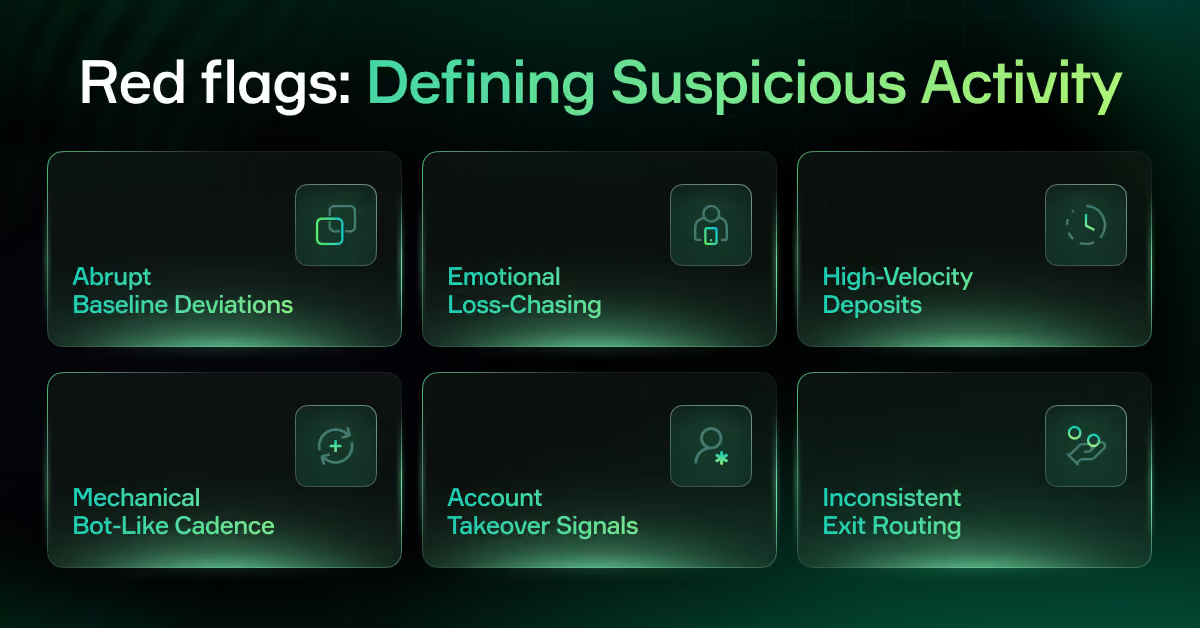
Fraud exposure in iGaming can appear at every stage of the player journey: identity and account abuse, device-based fraud, incentive fraud, gameplay and betting patterns, and acquisition fraud. The Soft2Bet Anti-Fraud solution treats any single check as just one component of that exposure. A check verifies one element at one moment, while the anti-fraud solution combines many elements into an overall picture of the account.
That difference defines how fraud prevention operates: signals are detected, lead to informed decisions, and are then documented. The Soft2Bet Anti-Fraud solution applies this logic to non-transactional elements as well, accumulating device, contact, and activity signals to detect fraud and open investigations. The Soft2Bet + SEON integration is a prime example of this logic in practice.
Why Fraud Prevention Needs Connected Controls, Not Isolated Checks
Fraud detection means finding suspicious patterns or events – an unusual login, a shared device, or betting that doesn’t match the account’s history. Detection only marks the issue for handling; what happens next depends on the prevention process that follows.
That process runs through several stages: detection, context evaluation, decision-making, investigation or control, documentation of the event, and adjustment based on the result. One identity check, device signal, or activity parameter describes one fraud vector, and every other vector needs its own kind of evidence. Multi-accounting, for example, leaves different traces from incentive abuse, which in turn leaves different traces from collusion.
Soft2Bet’s fraud-prevention architecture is built to tackle every possible vector at each stage of the player lifecycle. Different vectors surface at every stage, from acquisition onward, and they supply the core signals the Soft2Bet platform builds on.
Where Fraud Appears Across the Player Lifecycle
Fraud exposure changes at each step of the iGaming customer lifecycle. Acquisition can involve click-spam fraud; registration can involve false or synthetic identities; account access can involve takeovers and bot registrations; the play phase can involve multi-accounting, collusion, and incentive manipulation; and betting itself can show patterns that don’t fit typical activity.
Each of these fraud types leaves its own specific traces:
- Fake identity: Discrepancies between submitted data and verification sources.
- Account takeover: Device and access patterns that deviate from the account’s history.
- Incentive exploitation: Patterns across linked accounts, devices, or betting activity.
- Collusion: Coordinated timing and outcome patterns across multiple accounts.
Industry-wide data shows why this lifecycle view matters: iGaming fraud increases every year, and incentive-related exploitation accounts for nearly two-thirds of all iGaming fraud cases.
The same view applies to the Soft2Bet sportsbook, where betting patterns and reward mechanics are among the places incentive-related fraud tends to surface.
How Soft2Bet Builds Fraud Signals From Identity, Device, and Activity
Soft2Bet’s Anti-Fraud tool builds its Signal Layer from personal and contact information, device information, IP and geolocation data, and account activity history. Device fingerprinting, device velocity, IP reputation, geolocation verification, and proxy/VPN detection help identify suspicious devices and emulated or reset environments, while link analysis and activity profiling help uncover multi-accounting attempts.
The SEON integration adds another documented layer to this architecture. On the Soft2Bet platform, SEON’s Digital Footprint technology enriches account profiles, with email, phone, and IP signals helping to detect fake accounts. Machine-learning fraud scores and configurable rules are delivered through a single API.
None of these signals stands on its own. An isolated IP address, a shared device, or an unusual login is just another data point until it is combined with others – a proxy, or a device shared within a household, needs further evidence before it counts as fraud. The value of Soft2Bet’s signal layer lies in how these data points come together to produce a fraud score or an alert.
Transaction Fraud and Transaction Monitoring in iGaming
Transaction-layer fraud is a distinct type of exposure in iGaming. Card fraud, card testing, chargebacks, changes in transaction method, and anomalies in transaction activity all leave a trace: a difference between the account’s current transaction activity and its past behavior.
iGaming chargeback fraud rates run 2 to 4% higher than in other industries. A common monitoring technique compares an account’s current transactions with the pattern previously established for it. If an account that usually makes small transactions through a single method suddenly switches to large transactions through a new method, the monitoring system flags it for investigation. Card testing is caught with similar logic: it shows up as bursts of small-value transactions used to check whether a stolen card number works before it is used for a large payment.
Transaction fraud detection and AML transaction monitoring draw on much the same transaction data, but their objectives differ. The first evaluates whether specific transactions are fraudulent or manipulated. The second asks whether transaction activity points to potential money laundering or terrorist financing exposure, regardless of whether any individual transaction is fraudulent.
Turning Fraud Scores Into Real-Time Decisions
A fraud score or alert only matters once it influences something. On its own it is just a number; it becomes part of an operational control when it leads to a decision or a course of action – approval, a challenge, a block, or review by an analyst.
The Soft2Bet + SEON integration shows how this works in practice. Machine-learning fraud scores combine with user-defined rules, so some situations are handled automatically with minimal intervention while others are routed to analysts for review. That routing lets analysts focus on the cases where human judgment is genuinely needed.
The effect was noticeable: Soft2Bet and SEON reported 40% fewer manual queries and manual reviews completed 20% faster – figures that describe this specific Soft2Bet case.
Where Automated Detection Hands Off to Investigation
Automated detection is the scale layer of Soft2Bet’s fraud-prevention platform, continuously checking every user account and flagging suspicious activity. What it leaves to a human is evidence-based context: rules flag activity as suspicious, but a person must resolve it.

Soft2Bet’s Anti-Fraud Service includes case management that brings all the evidence about a player’s identity, device, and activity into one case, together with investigation notes. The SEON integration works the same way: any case that does not clear automated detection is flagged for a human to check.
Every investigation on the Soft2Bet platform closes with an action, and the human decision on the account is recorded alongside its reasoning. That is the purpose of automated scoring – to narrow the pool of activity that genuinely needs human attention.
KYC, AML/CFT, and Anti-Fraud: Related but Distinct Controls
KYC, AML/CFT, and anti-fraud controls draw on the same account data but answer different questions. KYC verifies the customer’s identity – the identity tied to the account itself. Anti-fraud checks whether that identity, account, device, or activity is being misused. AML/CFT examines exposure to financial crime, which can affect any account regardless of whether fraud is involved.
Soft2Bet KYC uses a tiered verification strategy – lighter for lower-concern accounts and with more steps for higher-concern ones – while still connecting to the account environment shared with Soft2Bet’s anti-fraud and AML/CFT controls. The Soft2Bet AML & CTF control targets the financial-crime layer specifically, covering document collection and the preparation of required reports.
All three controls operate in the same context: they rely on the same account record, but each has its own purpose and action.
PAM as Shared Context for Fraud Case Review
The Soft2Bet Player Account Management (PAM) solution is the shared operational context in which these processes run. The player’s profile, KYC verification status, account history, and alert and fraud signals all sit in one Soft2Bet context.
That shared context reduces the effort a reviewer needs to decide on a flagged account. Within Soft2Bet’s PAM, KYC/AML status, account and event context, and fraud alerts stay connected, all linked to the player record used for Soft2Bet’s anti-fraud monitoring and investigation. Centralizing context this way cuts the work of gathering and correlating relevant information.
Explainability, False Positives, and the Feedback Loop
A fraud-prevention decision is only useful if the operator can explain it. Soft2Bet’s Anti-Fraud service attaches reason codes to each decision, showing which signals or rules drove it, and keeps case histories as an audit record.
False positives are the other side of the equation: a system is useful when it catches more while adding less friction for legitimate users. Soft2Bet’s anti-fraud service tracks false-positive rates alongside detection rates and treats the relationship as a balance under its own control. Low friction matters here for the same reason responsible gambling tools need to be easy to find and use: a control only works when it fits the way real players use the product.
This feedback is the basis for calibrating Soft2Bet’s rules and models. Case outcomes and user appeals determine when and where a rule or model is adjusted, because fraud patterns evolve and have to be tracked continuously.
Fraud Prevention as a Connected, Adapting System
Whatever the context – identity, device, or activity markers, KYC/AML/CFT status, or investigative data – the same logic applies. Detection shows what needs attention; prevention is the connected mechanism that turns that attention into decisions and action. Soft2Bet’s Anti-Fraud service and its partnership with SEON show this system at work.
As fraud patterns evolve, the algorithms behind prevention must be evaluated and updated continuously. That is how Soft2Bet keeps its fraud-prevention architecture working as exposure changes.