
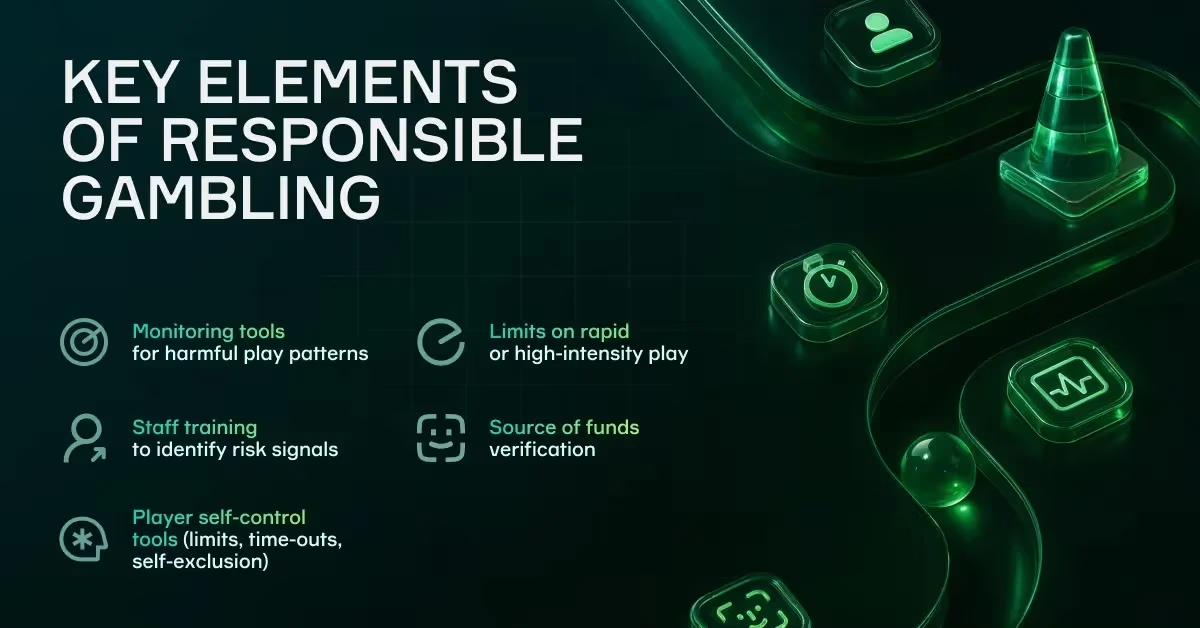
Responsible gambling features in iGaming include a set of controls for managing spending, time, breaks, and access to an account. Each one is a safeguard with a distinct function: a deposit limit caps spending, a reality check helps players stay aware of their situation, a time-out provides a temporary break, and self-exclusion blocks access to the platform. Every safeguard in Soft2Bet’s set does a specific job, and players choose the one that suits them at the time. Together, these safeguards support Soft2Bet’s approach to responsible gambling.
Matching Each Control to a Specific Player Need
Soft2Bet offers a range of tools to support responsible gambling, including:
- Deposit or loss limit: Caps how much a player can deposit into their account, or how much they are prepared to lose.
- Reality check: Alerts players to time or spending information that can be overlooked during play.
- Time-out: Lets players suspend their access to the platform temporarily, for a set period.
- Self-exclusion: Lets players restrict access to their account for a predetermined period.
Each of these proprietary tools is designed to address a distinct aspect of play.
How Deposit Limits and Loss Limits Bound Spend Differently
Deposit limits and loss limits both belong to Soft2Bet’s spending controls, but they bound different things. A deposit limit restricts how much a player puts into their account over a set period, regardless of what happens to that money afterward. Soft2Bet’s loss limit restricts how much a player loses over the same period. A player can deposit more than once in that period and still stay within the loss limit, as long as the recorded outcome remains inside it.
Soft2Bet treats both as part of its control set and offers them to players as separate instruments. Their value lies in being visible: players can see the limits, understand them, and adjust them as needed. Soft2Bet makes them accessible wherever the player is, with a clear description of what each limit does.
Responsible gambling tools bring real benefits: players who set a deposit limit reduced their spending substantially compared with those who didn’t, even though only a small share of players set one voluntarily in the first place. That gap between benefit and uptake points to accessibility and clarity – the factors Soft2Bet’s deposit and loss limits are built to address.
Reality Checks and Time-Outs: Awareness Versus a Pause in Play
Reality checks and time-outs both sit in the time dimension of Soft2Bet’s control framework, but they do different jobs. A reality check is a reminder that prompts players to reflect on how long they have been playing, giving them a moment to assess the situation and decide what to do next. A time-out is a pause – a player-selected break that locks access to the account for a limited time while keeping the account itself open.
Soft2Bet places these reminders and pauses at specific points in the player journey so they are easy to notice. Depending on the market and operator policies, Soft2Bet also provides session limits, which add another restriction on session length. Where they apply, session limits fall into the same time and awareness category as reality checks and time-outs.
Seen this way, awareness reminders and time-outs form a category of their own, separate from spend-side measures such as deposit and loss limits. At Soft2Bet, reality checks and time-outs complement deposit and loss limits: one type of control manages how much a player commits, the other manages how long they play and how aware they stay. That is why a player who already has deposit and loss limits in place can still benefit greatly from a reminder or a time-out.
Why Self-Exclusion Works Differently From a Limit or a Break
Self-exclusion acts directly on access. Deposit limits, loss limits, reality checks, and time-outs all let a player keep playing within adjusted parameters – the amount, the time span, or the level of awareness. Self-exclusion instead lets users suspend their accounts for a specified period, giving them the chance to step away from the site completely. Soft2Bet regards self-exclusion as a player-facing safeguard, and the ability to pause play entirely for a set period is what sets it apart from other controls.
At Soft2Bet, self-exclusion is a player-initiated safeguard with a pivotal role in how player protection works. When a player chooses to self-exclude, Soft2Bet restricts that player’s account access for the specified exclusion period, in line with Soft2Bet’s policy and market requirements, so the exclusion applies across all products. The length of the suspension and the account reactivation procedure depend on market rules and operator policy.
Because an exclusion has to follow the right person across every product, it builds on the verified identity that Soft2Bet’s KYC process establishes for each account.
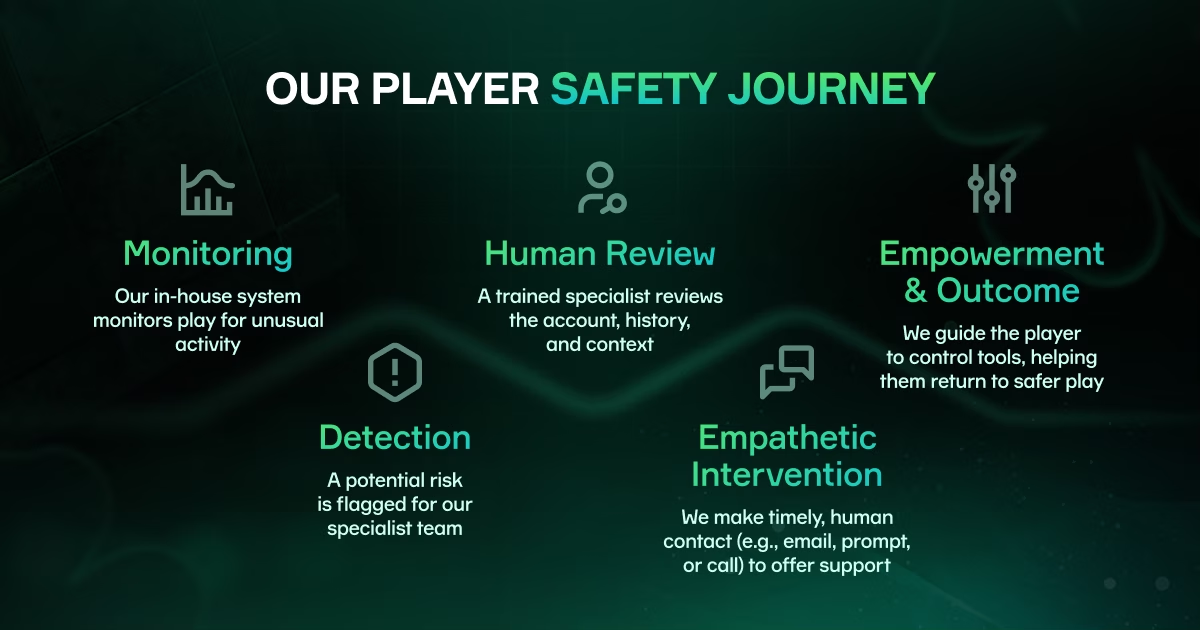
Self-exclusion remains central to Soft2Bet’s player-protection approach, even as Soft2Bet layers ongoing account monitoring alongside it. That monitoring complements player-requested safeguards and operates as a separate layer from a player’s own decision to exclude, much like the signal-based monitoring behind Soft2Bet’s fraud prevention.
What Turns a Control Into a Working Safeguard
A control becomes a safeguard when players can find it, understand what it does, and use it easily. Soft2Bet designs its responsible gambling controls so that deposit limits, loss limits, reality checks, time-outs, and self-exclusion are all accessible from the responsible gambling page.
Clear language is the other design principle. Each control comes with a plain explanation of what it does and how long it lasts, so players can make an informed choice about which one suits their needs. Soft2Bet’s aim is for setting limits or taking a break to be quick and straightforward for every user.
Most players know these tools exist, but whether that awareness turns into regular use often depends on how clearly a tool is presented. Making features easy to reach and clearly explained is what makes them useful on Soft2Bet’s platform.
Player Controls as One Layer of a Wider RG System
In Soft2Bet’s system, deposit limits, loss limits, reality checks, time-outs, and self-exclusion each target a separate aspect of gambling: spending, awareness, pace, and access. Soft2Bet uses that distinction as the basis of its control system, with every control confirmed and available from the parts of the product a player already knows. A control’s effectiveness depends as much on how easy it is to discover and how clearly it is worded as on the control itself, because a safeguard only works when it is used.
Within Soft2Bet’s system, these controls form one part of a wider responsible gambling strategy that runs through the Soft2Bet platform as a whole.